
02 / Software Intelligence
PRISM
Behavior Specification Graph for Legacy Modernization
Legacy modernization fails when nobody can say what must not change.
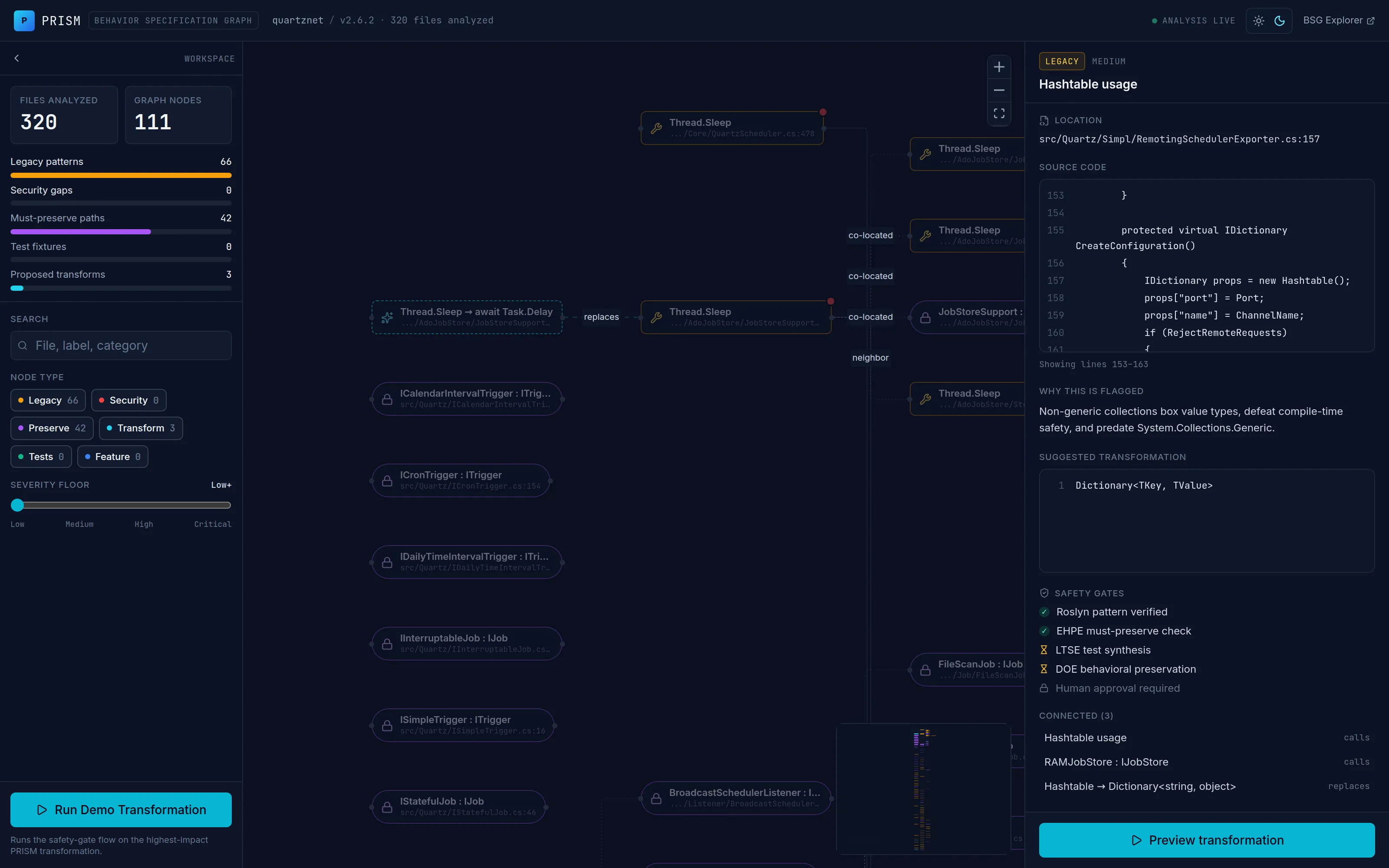
Large legacy systems resist modernization for a specific reason: their observable behavior is the specification, and that specification lives nowhere except the code. Rewriting without a behavior map risks breaking the very contracts the system exists to honor.
PRISM makes the specification explicit. Its analyzers generate a Behavior Specification Graph: a typed graph of entry points, core behavior, dependencies, outputs, assurance hooks, and risk signals, where every node carries file, line, and source-snippet evidence and every edge carries a confidence and a rationale. Run against Quartz.NET v2.6.2, the analyzer processed 320 files into a graph of legacy patterns, must-preserve contracts, and proposed rewrites.
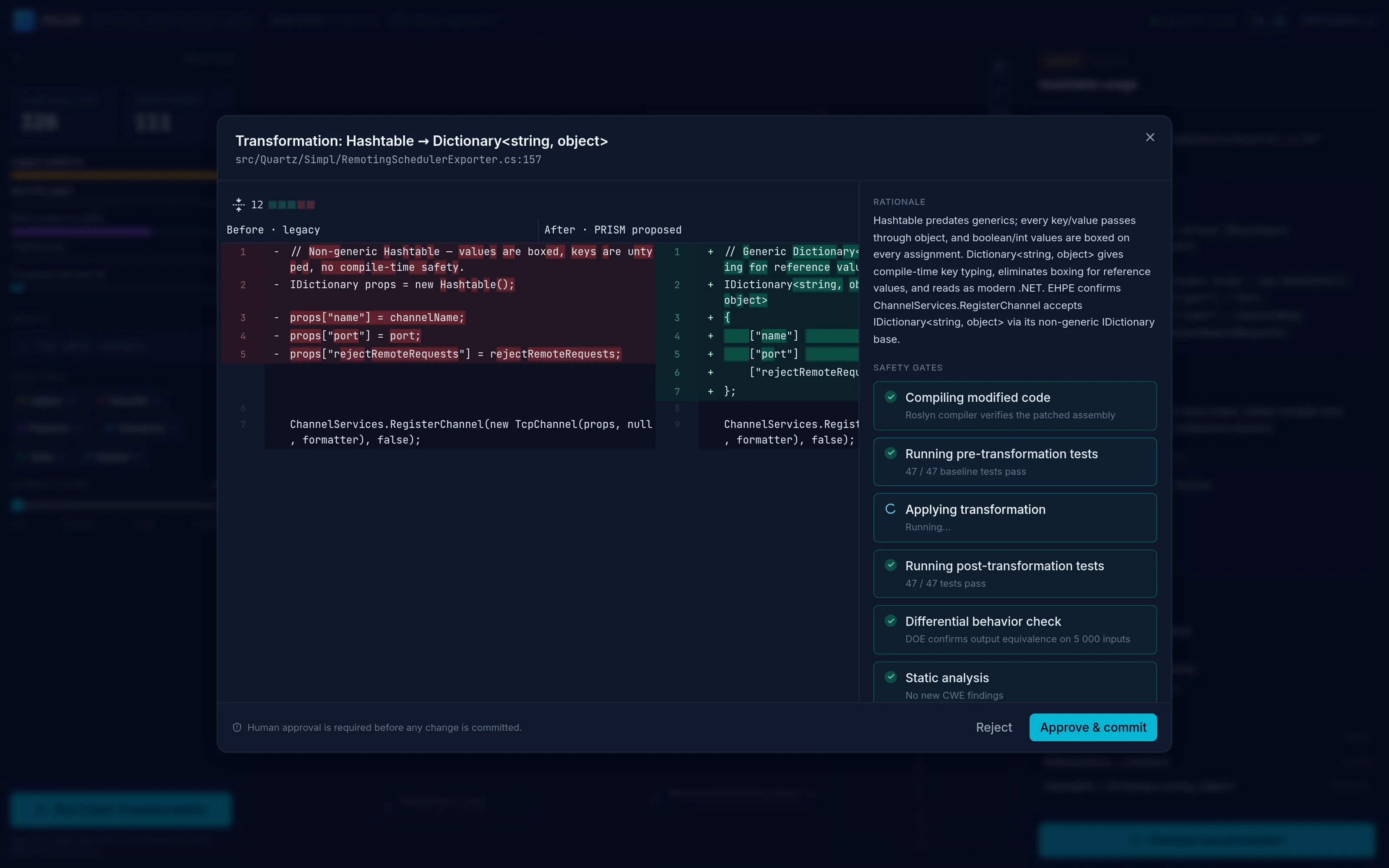
Proposed changes move through a safety-gate workflow: compile verification, pre- and post-transformation tests, differential behavior checking, and static analysis. The final gate is not negotiable: human approval is required before any change is committed.
From code to approved change
- Analyze Static analyzers walk the codebase and extract entry points, behavior, dependencies, and risk signals.
- Map Findings assemble into the Behavior Specification Graph, with evidence anchored to file and line.
- Flag Legacy patterns, security gaps, and must-preserve paths are surfaced with severity and rationale.
- Propose PRISM drafts behavior-preserving transformations as reviewable before-and-after diffs.
- Gate Safety gates check compilation, tests, and behavioral equivalence. A human approves or rejects every change.
Inside the system
Working on problems PRISM addresses?
We collaborate with government organizations, research institutions, and technology partners. Tell us what you are trying to solve.